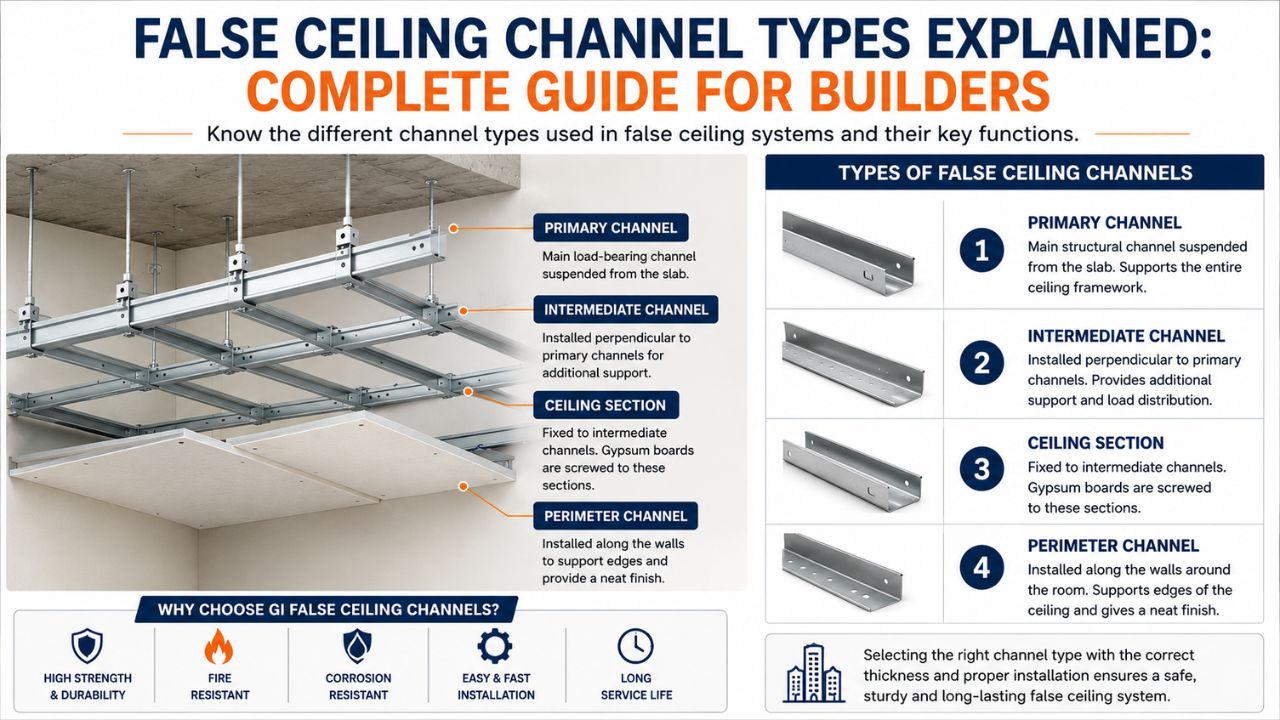
False Ceiling Channel Types Explained: A Complete Guide for Builders & Contractors
Whether you’re constructing a commercial office, hospital, shopping mall, residential apartment, or industrial facility, a false ceiling is only as reliable as the framework supporting it. While gypsum boards and ceiling tiles are visible after installation, the galvanized iron (GI) channel system hidden above them carries the actual structural load.
Choosing the wrong ceiling channel can lead to sagging ceilings, cracks, misalignment, increased maintenance costs, and reduced service life. That’s why understanding False Ceiling Channel Types Explained is essential for builders, contractors, architects, interior designers, and procurement teams before selecting a ceiling framing system.
This guide explains the different types of GI false ceiling channels, their applications, standard specifications, installation considerations, and the key factors to evaluate before purchasing.
What Are False Ceiling Channels?
False ceiling channels are galvanized steel framing members that create the supporting framework for gypsum board ceilings. They distribute loads evenly, maintain structural alignment, and provide a secure base for ceiling boards, lighting fixtures, HVAC ducts, and other services.
Unlike traditional wooden framing, GI channels offer:
- Higher structural strength
- Better corrosion resistance
- Excellent dimensional stability
- Fire resistance
- Longer service life
- Faster installation
Because of these advantages, GI channels have become the preferred choice for modern residential, commercial, healthcare, educational, and industrial projects.
Understanding the Different Types of False Ceiling Channels
A complete false ceiling framework consists of multiple channels working together. Each serves a specific purpose.
Primary Channel
Primary channels form the main structural support of the ceiling system. They transfer loads to the suspension hangers connected to the building structure.
Applications include:
- Commercial buildings
- Hospitals
- Shopping malls
- Office ceilings
- Industrial buildings
Primary channels carry the majority of the ceiling load, making their thickness and steel quality extremely important.
Intermediate Channel
Intermediate channels connect to the primary channels and provide additional support across the ceiling.
Their responsibilities include:
- Improving structural rigidity
- Reducing panel deflection
- Distributing weight evenly
- Supporting gypsum boards
Proper spacing of intermediate channels improves the overall strength of the ceiling system.
Ceiling Section
Ceiling sections directly support gypsum boards.
They are designed with precise dimensions that allow easy screw fixing while maintaining a smooth ceiling surface.
Benefits include:
- Better board alignment
- Strong screw holding capacity
- Faster installation
- Improved finishing quality
Perimeter Channel
Perimeter channels are fixed along the walls surrounding the room.
Their role is to:
- Support ceiling edges
- Maintain alignment
- Create neat finishing lines
- Reduce movement around room boundaries
Without perimeter channels, false ceilings can lose stability over time.
Suspension Components
Although not channels themselves, suspension rods, hangers, clips, brackets, and fasteners complete the false ceiling framework by transferring loads safely to the building slab.
Using compatible accessories ensures better performance and longer service life.
Why is Galvanized Steel Used for False Ceiling Channels?
Galvanized steel is preferred because it combines structural strength with corrosion resistance.
The zinc coating protects the steel from moisture, reducing the chances of rust formation during years of service.
Advantages include:
- Excellent durability
- Rust resistance
- Fire-resistant properties
- Low maintenance
- Better dimensional accuracy
- Long service life
For commercial buildings where ceilings remain installed for decades, galvanized steel provides dependable long-term performance.
How Do You Choose the Right False Ceiling Channel?
Choosing the correct channel depends on more than price alone.
Builders should evaluate:
- Steel thickness
- Zinc coating quality
- Structural load requirements
- Ceiling span
- Building application
- Manufacturer quality standards
- Dimensional accuracy
- Installation compatibility
Selecting high-quality channels reduces maintenance costs and improves project reliability.
What Should You Check Before Buying GI Ceiling Channels?
Before placing an order, verify the following:
✔ Steel thickness
✔ Uniform galvanization
✔ Straight profile without twisting
✔ Accurate punching dimensions
✔ Consistent profile shape
✔ Quality certifications
✔ Manufacturer experience
✔ Packaging quality
✔ Delivery capability
✔ Technical support
A reliable manufacturer provides complete technical information rather than only price quotations.
Where Are False Ceiling Channels Used?
GI ceiling channel systems are widely used across multiple sectors.
Common applications include:
- Office buildings
- Hospitals
- Hotels
- Shopping malls
- Educational institutions
- Airports
- Residential apartments
- Warehouses
- Industrial facilities
- Government buildings
Their versatility makes them suitable for both lightweight and heavy-duty ceiling systems.
Common Mistakes Builders Should Avoid
Many ceiling failures occur because of avoidable mistakes.
Common issues include:
- Choosing thinner channels to reduce costs
- Ignoring galvanization quality
- Incorrect channel spacing
- Poor suspension layout
- Using incompatible accessories
- Improper screw fixing
- Purchasing from unverified suppliers
Following manufacturer recommendations significantly improves ceiling durability and safety.
Why Choose Rudran Infra Metals?
Rudran Infra Metals manufactures precision-engineered GI framing solutions designed for modern construction projects.
Our strengths include:
- Precision roll-formed profiles
- High-quality galvanized steel
- Consistent dimensional accuracy
- Strict quality inspection
- Reliable production capacity
- Timely delivery
- Technical assistance for project requirements
Conclusion
Understanding False Ceiling Channel Types Explained helps builders and contractors choose the right framing system for safe, durable, and long-lasting false ceilings. From primary channels and ceiling sections to perimeter framing and suspension accessories, every component contributes to the strength and stability of the finished ceiling. Selecting quality galvanized steel channels from a trusted manufacturer reduces maintenance, improves installation efficiency, and delivers reliable performance throughout the building’s lifespan.
Contact Rudran Infra Metals today to discuss your requirements, request technical specifications, or get expert guidance on selecting the right ceiling framing system for residential, commercial, or industrial applications.
Frequently Asked Questions
1. What are the main False Ceiling Channel Types Explained in this guide?
The main False Ceiling Channel Types Explained include primary channels, intermediate channels, ceiling sections, perimeter channels, and suspension components used together to create a stable ceiling framework.
2. Which false ceiling channel carries the maximum load?
Among the False Ceiling Channel Types Explained, the primary channel carries most of the structural load and transfers it safely to the suspension system.
3. Why are GI channels preferred for false ceilings?
The False Ceiling Channel Types Explained use galvanized steel because it offers excellent corrosion resistance, durability, fire resistance, and dimensional stability.
4. What thickness is commonly used for GI ceiling channels?
The False Ceiling Channel Types Explained are available in different thicknesses depending on project requirements, structural loads, and manufacturer specifications.
5. Can false ceiling channels be used in commercial buildings?
Yes. The False Ceiling Channel Types Explained are widely used in offices, hospitals, shopping malls, hotels, airports, and industrial buildings due to their strength and long service life.