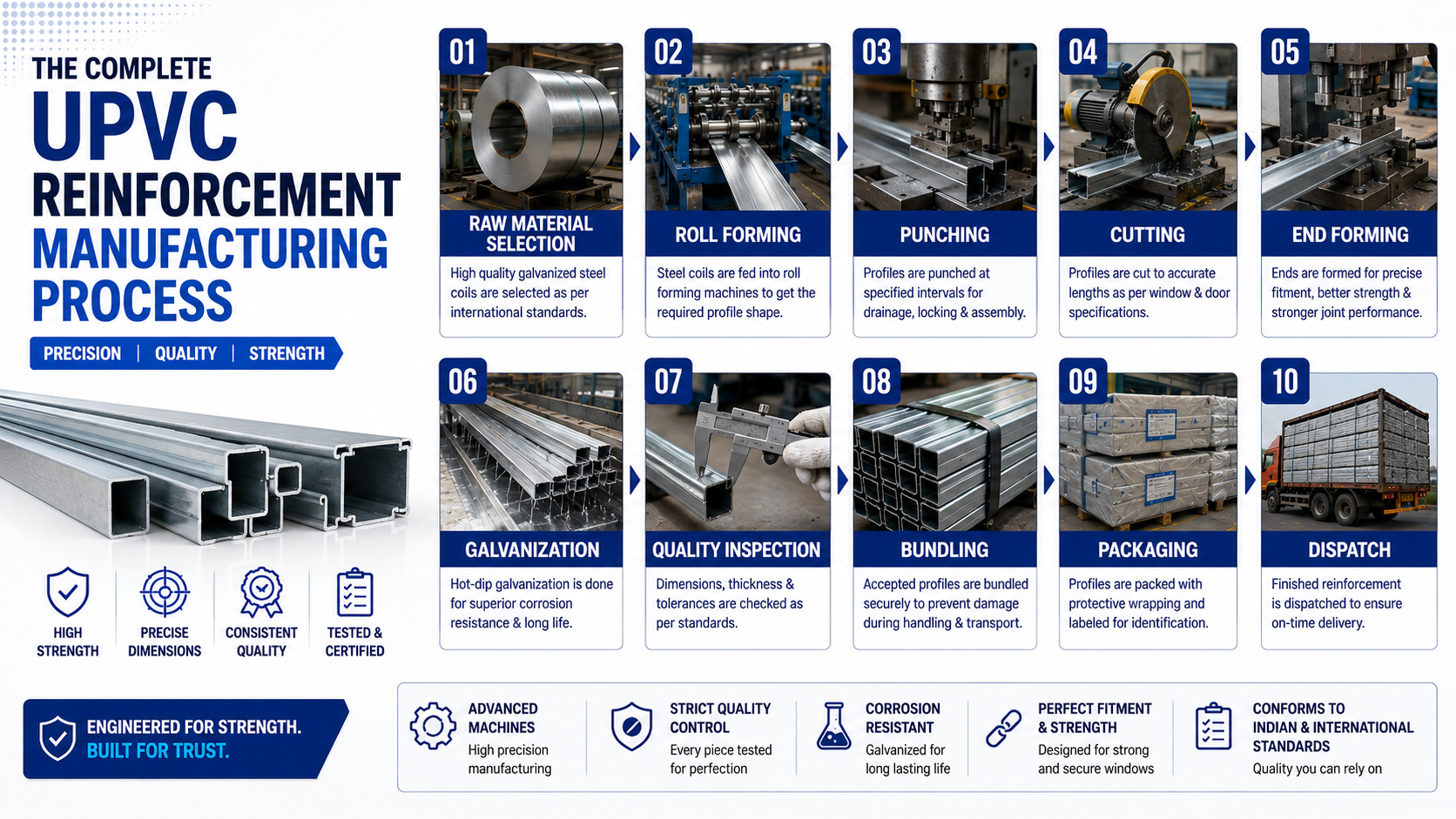
The Complete UPVC Reinforcement Manufacturing Process From Raw Steel To Finished Profiles
When fabricators receive a bundle of UPVC reinforcement profiles, they usually see only the finished product. What remains hidden is the journey that profile has taken through multiple manufacturing stages before reaching the production floor.
Every reinforcement section used inside a uPVC window or door begins as a steel coil. Through a carefully controlled process involving roll forming, shaping, inspection, and quality verification, that raw material is transformed into a precision-engineered component capable of supporting modern window systems.
In this factory tour, we’ll walk through the complete UPVC reinforcement manufacturing process and examine the quality checkpoints that ensure every profile meets industry expectations.
Why Understanding The Manufacturing Process Matters
For many buyers, reinforcement steel is often viewed as a commodity product. However, the manufacturing process directly influences:
- Structural strength
- Dimensional accuracy
- Corrosion resistance
- Hardware holding performance
- Long-term durability
Understanding how reinforcement is produced allows fabricators to make informed purchasing decisions and better evaluate supplier capabilities.
A manufacturer with a robust production process is more likely to deliver consistent quality across every batch.
Stage 1: Raw Material Selection
The UPVC reinforcement manufacturing process begins with selecting suitable steel coils.
The quality of the final profile depends heavily on the quality of the incoming raw material. Manufacturers typically source galvanized or cold-rolled steel coils that meet predefined specifications for thickness, strength, and surface quality.
Before production begins, incoming coils undergo inspection to verify:
- Thickness consistency
- Surface condition
- Width accuracy
- Coating quality
- Material certification
Any variation at this stage can affect downstream production and final profile performance.
Quality Checkpoint #1
Incoming material is inspected to ensure it matches the required manufacturing specifications before being released to production.
Stage 2: Coil Loading And Decoiling
Once approved, steel coils are moved to the production line.
Large coils are mounted onto decoiling equipment that gradually unwinds the material and feeds it into the roll-forming system.
This stage may appear simple, but maintaining stable feeding conditions is critical. Uneven feeding can affect profile dimensions and production consistency.
Modern manufacturing lines use controlled feeding mechanisms to ensure smooth material movement throughout the process.
Factory Tour Insight
A typical production line may process hundreds of meters of steel every hour while maintaining tight dimensional tolerances.
Stage 3: Precision Roll Forming
Roll forming is the heart of the UPVC reinforcement manufacturing process.
As the steel strip moves through a sequence of specially designed rollers, it is gradually shaped into the required reinforcement profile.
Instead of bending the steel in a single operation, multiple roller stations progressively form the material into its final geometry.
This method offers several advantages:
- Consistent dimensions
- High production speed
- Reduced material stress
- Better profile accuracy
Different roller configurations are used depending on whether the manufacturer produces U sections, C sections, box profiles, or customized reinforcement designs.
Quality Checkpoint #2
Operators continuously monitor profile dimensions to ensure consistency throughout the production run.
Stage 4: Profile Shaping And Dimensional Control
As the reinforcement moves through the forming stages, profile geometry becomes increasingly precise.
Dimensional control is essential because even minor deviations can create fitting problems inside uPVC profiles.
Manufacturers regularly verify:
- Width
- Height
- Wall dimensions
- Profile symmetry
- Straightness
Consistent dimensions help fabricators achieve smoother assembly and better hardware installation.
Factory Tour Insight
Many manufacturers use digital measuring tools to verify dimensions during production rather than waiting until final inspection.
Stage 5: Cutting To Required Lengths
After forming, reinforcement profiles are cut into predefined lengths according to customer requirements.
Different fabricators may require different profile lengths based on their production systems.
Automated cutting equipment helps ensure:
- Accurate lengths
- Clean edges
- Consistent output
- Reduced material waste
Proper cutting accuracy improves production efficiency at the fabrication stage.
Quality Checkpoint #3
Cut lengths are checked periodically to confirm compliance with customer specifications.
Stage 6: Surface Inspection And Visual Examination
Before packaging, profiles undergo detailed visual inspection.
Although reinforcement remains hidden inside uPVC profiles, surface quality remains important because defects can indicate manufacturing issues.
Inspectors look for:
- Surface scratches
- Coating irregularities
- Forming defects
- Edge damage
- Deformation
Profiles that fail inspection are removed from the production batch.
Stage 7: Galvanization And Corrosion Protection
Corrosion resistance is one of the most important performance factors in reinforcement manufacturing.
Many reinforcement profiles are produced using galvanized steel, which incorporates a protective zinc coating.
The galvanization process helps protect the steel from moisture exposure and environmental conditions that may contribute to corrosion over time.
Common coating specifications include:
- 120 GSM
- 180 GSM
- 275 GSM
The required coating level often depends on the intended application and environmental conditions.
Why Galvanization Matters
A quality zinc coating helps:
- Extend service life
- Reduce corrosion risk
- Improve durability
- Enhance long-term performance
Quality Checkpoint #4
Coating consistency is verified through inspection procedures designed to ensure uniform protection.
Stage 8: Mechanical And Performance Testing
Before profiles are approved for shipment, manufacturers conduct various quality evaluations.
Testing helps confirm that the reinforcement can perform reliably in real-world applications.
Typical evaluations may include:
Thickness Verification
Confirms material consistency.
Dimensional Testing
Ensures profile accuracy.
Straightness Inspection
Checks profile alignment.
Coating Evaluation
Verifies corrosion protection standards.
Structural Assessment
Evaluates profile integrity and performance characteristics.
These tests help maintain consistency across production batches.
Stage 9: Packaging And Dispatch
Once profiles pass quality inspections, they are bundled and prepared for dispatch.
Packaging is designed to protect profiles during transportation and storage.
Manufacturers often use:
- Protective wrapping
- Bundled packaging
- Identification labels
- Batch traceability systems
Proper packaging helps preserve product quality until it reaches the fabricator.
How Quality Control Supports Better Fabrication
The best manufacturers don’t rely solely on final inspections.
Quality control is integrated throughout the UPVC reinforcement manufacturing process, from raw material inspection to finished product verification.
This approach helps identify potential issues early and reduces variability between production batches.
For fabricators, this means:
- Better profile fitment
- Consistent hardware installation
- Reduced production delays
- Improved finished product quality
What Buyers Should Look For In A Reinforcement Manufacturer
Selecting a reinforcement supplier should involve more than simply comparing prices.
Important factors include:
- Manufacturing capability
- Quality control procedures
- Material traceability
- Coating standards
- Production consistency
- Technical expertise
Manufacturers who openly share their production methods often build stronger trust with customers than those who provide limited information about their manufacturing practices.
Conclusion
The UPVC reinforcement manufacturing process involves far more than simply shaping steel into a profile. Every stage-from raw material selection and roll forming to inspection and packaging-contributes to the quality of the final product.
Understanding how reinforcement is manufactured helps fabricators appreciate the importance of material quality, dimensional accuracy, and corrosion protection.
As demand for higher-performing window systems continues to grow, manufacturers that prioritize quality control and production transparency will play an increasingly important role in the uPVC industry.
Looking for a reliable UPVC reinforcement manufacturer with strict quality control standards?
Contact our team today to discuss your reinforcement profile requirements and production specifications.
FAQs
1. What is the UPVC reinforcement manufacturing process?
The UPVC reinforcement manufacturing process involves converting steel coils into precision-engineered reinforcement profiles through roll forming, inspection, and quality control procedures.
2. How is UPVC reinforcement made?
UPVC reinforcement is made by feeding steel coils through roll-forming equipment that gradually shapes the material into the required profile design.
3. Why is roll forming used in the UPVC reinforcement manufacturing process?
Roll forming provides consistent dimensions, high production efficiency, and accurate profile geometry.
4. What role does galvanization play in reinforcement manufacturing?
Galvanization protects steel against corrosion and improves long-term durability.
5. Why are quality checks important during the manufacturing process?
Quality checks help ensure dimensional accuracy, coating consistency, and reliable product performance.