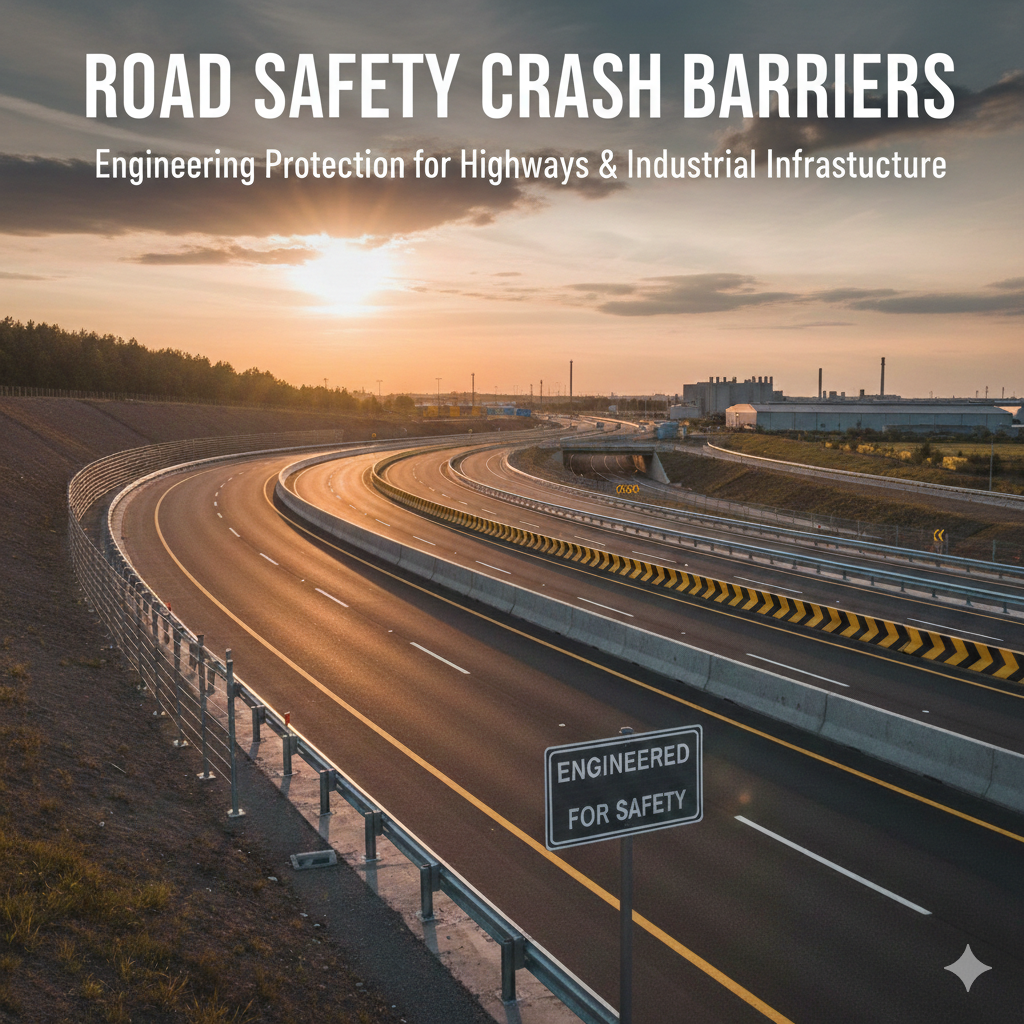
As highway expansion and industrial corridor development accelerate across India, road safety is no longer just about signage and lane markings. Structural crash protection systems have become a critical component of infrastructure planning.
Road safety crash barriers are designed to reduce accident severity, absorb impact energy, and prevent vehicles from leaving the roadway.
For a precision-driven road safety crash barrier manufacturer in Hyderabad, the focus goes beyond metal forming — it is about engineered impact resistance.
What Are Road Safety Crash Barriers?
Road safety crash barriers (commonly W-beam or thrie-beam systems) are longitudinal metal guardrail systems installed along:
-
Highways
-
Expressways
-
Bridges
-
Curves and medians
-
Industrial roads
-
Logistics parks
Their purpose is to:
-
Redirect errant vehicles
-
Minimize collision impact
-
Protect pedestrians and roadside assets
-
Reduce fatal crossovers
These barriers must be engineered to perform under high-speed impact conditions.
Structural Engineering Behind Crash Barriers
Crash barriers are not ordinary steel profiles. They are engineered systems comprising:
-
W-beam guardrails
-
Thrie-beam panels
-
Steel posts
-
Spacer blocks
-
Fasteners and anchoring components
Precision roll-forming ensures uniform cross-sectional geometry, which directly affects energy absorption performance during impact.
A reliable crash barrier manufacturer Hyderabad must maintain:
-
Structural-grade steel thickness
-
Accurate hole punching
-
Controlled galvanization
-
Compliance with IRC & MoRTH specifications
Even minor dimensional variation can compromise structural performance.
Importance of Galvanization & Corrosion Protection
Crash barriers are continuously exposed to:
-
Rain and humidity
-
Extreme heat
-
Dust and pollution
-
Mechanical vibration
-
Impact stress
Proper hot-dip galvanization protects the barrier against corrosion and extends its operational lifespan.
A technically capable road safety crash barrier manufacturer in Hyderabad ensures uniform zinc coating thickness to maintain structural integrity for years.
Applications Beyond Highways
Road safety crash barriers are widely used in:
-
Industrial manufacturing zones
-
Ports and shipping yards
-
Warehouses and logistics centers
-
Perimeter protection
-
Bridge approaches
Industrial crash barriers protect both human life and infrastructure assets from vehicle impact damage.
As infrastructure becomes more automated and high-speed, protective barrier systems become essential.
Production Scalability for Infrastructure Projects
Highway stretches require bulk supply of:
-
Guardrail panels
-
Posts
-
End terminals
-
Fasteners
Infrastructure projects operate on strict execution timelines. A capable road safety crash barrier manufacturer in Hyderabad must provide:
-
High-volume production capacity
-
Batch consistency
-
Project-based dispatch coordination
-
On-time delivery support
Fragmented sourcing often results in thickness variation and alignment inconsistencies.
Integrated roll-forming manufacturing ensures uniformity across large project stretches.
Why Manufacturing Precision Matters
Crash barriers must absorb kinetic energy and redirect vehicles safely. Their structural behavior during impact depends on:
-
Steel grade
-
Profile design
-
Thickness accuracy
-
Post spacing
-
Anchoring strength
Cold roll-forming provides dimensional consistency essential for predictable impact response.
Engineering-driven manufacturing ensures compliance and reliability.
Conclusion
Road safety crash barriers are a structural necessity in modern infrastructure development. They protect highways, industrial zones, and urban roads from high-risk impact scenarios.
Rudran Infra Metals manufactures precision roll-formed road safety crash barriers engineered for durability, compliance, and large-scale infrastructure deployment.
Because infrastructure growth must be supported by engineered safety systems.