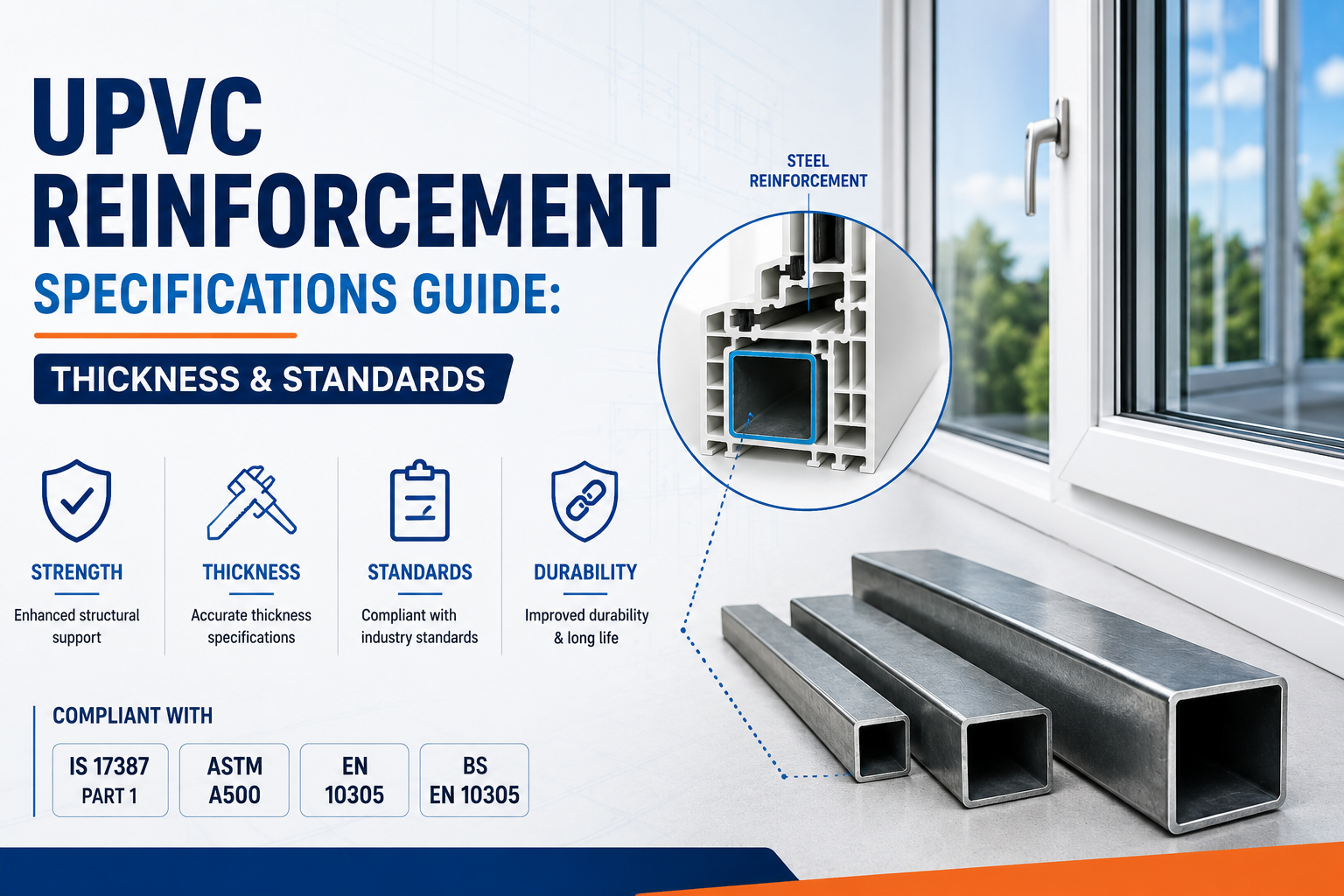
Complete UPVC Reinforcement Specifications Guide: Thickness & Standards
When customers evaluate a UPVC window, they usually notice the profile design, glass quality, and hardware finish. What they don’t see is the component that often determines how well that window performs years later-the reinforcement hidden inside the frame.
For fabricators, reinforcement is much more than a steel insert. It is the structural element that helps a window maintain its shape, supports hardware fasteners, and provides the strength needed to withstand daily use. Choosing the wrong specification can lead to service issues, callbacks, and dissatisfied customers.
As the demand for larger windows, premium homes, and commercial glazing systems continues to grow, understanding UPVC reinforcement specifications has become increasingly important. Fabricators who understand reinforcement requirements are better positioned to deliver products that perform consistently in different environments and applications.
This guide explores the key specifications that influence reinforcement quality, including thickness selection, galvanized coating standards, steel grades, compliance requirements, and practical selection considerations.
Why UPVC Reinforcement Specifications Matter
Every fabricated window is exposed to forces that gradually affect its performance. Opening and closing cycles, wind pressure, temperature changes, and hardware loads all place stress on the frame.
Without properly specified reinforcement, these stresses can eventually lead to:
- Frame distortion
- Alignment issues
- Locking problems
- Hardware loosening
- Reduced operational life
UPVC reinforcement specifications provide a framework for selecting material that can handle these demands. When reinforcement matches the application requirements, the finished product remains stable and reliable for a longer period.
Fabricators who prioritize specifications during procurement often experience fewer installation issues and lower after-sales maintenance requirements.
Understanding Reinforcement Thickness Selection
Thickness is one of the first specifications buyers evaluate, but selecting the correct thickness involves more than choosing the highest available number.
Different projects have different structural requirements. A compact residential window experiences significantly different loads compared to a large commercial installation.
Common Thickness Options
| Thickness | Typical Application |
| 1.0 mm | Small residential openings |
| 1.2 mm | Standard sliding systems |
| 1.5 mm | Casement windows and doors |
| 2.0 mm | Commercial projects |
| 2.5 mm – 3.0 mm | Heavy-duty structural applications |
Many fabricators prefer 1.2 mm or 1.5 mm reinforcement for standard residential work because these options offer a practical balance between performance and material cost.
However, larger openings may require thicker reinforcement to maintain frame stability and prevent excessive movement over time.
Factors Affecting Thickness Selection
Before finalizing reinforcement thickness, consider:
- Window dimensions
- Wind exposure
- Building height
- Hardware weight
- Customer performance expectations
The correct choice should be based on project requirements rather than adopting a single specification for every installation.
Zinc Coating Standards And Their Importance
Corrosion protection is often overlooked until visible problems begin to appear. Since reinforcement remains enclosed inside the profile, rust formation may remain hidden for years.
This is where galvanized coating plays an important role.
The zinc layer applied to reinforcement steel helps shield the base material from moisture and environmental exposure. Higher coating levels generally provide greater protection, particularly in challenging environments.
Common Coating Levels
| Zinc Coating | Typical Usage |
| 120 GSM | Basic indoor environments |
| 180 GSM | Standard residential projects |
| 275 GSM | Coastal and high-humidity regions |
A project located near the coast experiences very different environmental conditions compared to one in a dry inland city. Matching coating standards to the installation environment can significantly improve product durability.
Fabricators serving multiple regions often keep different coating options available to accommodate varying project requirements.
Understanding IS 277 Compliance
Material quality cannot be judged by appearance alone. industry standards provide measurable benchmarks that help ensure consistency and reliability.
IS 277 is an indian standard covering galvanized steel sheets and coils. It establishes guidelines related to:
- Zinc coating quality
- Material dimensions
- Surface condition
- Manufacturing consistency
- Corrosion resistance characteristics
For fabricators, sourcing reinforcement that aligns with recognized standards offers greater confidence in material quality.
While specifications may vary depending on project requirements, compliance with established standards helps reduce uncertainty during procurement and production.
Steel Grades Used in Reinforcement Manufacturing
Not all steel behaves the same way during fabrication or in service conditions.
The grade of steel selected influences several performance characteristics, including strength, formability, dimensional accuracy, and screw retention.
Commonly Used Materials
Cold Rolled Steel
Known for its consistent thickness and smooth surface finish, cold rolled steel is commonly used when dimensional precision is important.
Galvanized Cold Rolled Steel
This material combines dimensional accuracy with corrosion protection, making it a preferred option for many reinforcement manufacturers.
High-Strength Steel
Used for demanding applications where additional structural capacity is required.
The selection of steel grade should always align with the intended application rather than focusing solely on price.
Common issues Linked To Poor Reinforcement Selection
Many fabrication problems can be traced back to inadequate reinforcement specifications.
Frame Movement
insufficient structural support may allow the frame to flex under load.
Reduced Screw Holding
Weak reinforcement can affect hardware attachment strength.
Corrosion-Related Problems
Poor coating quality may accelerate deterioration in humid environments.
Fabrication Challenges
Dimensional inconsistencies can create difficulties during production.
increased Maintenance Requirements
Substandard reinforcement often contributes to service calls and adjustments after installation.
Avoiding these issues begins with selecting reinforcement that meets project demands from the start.
How Fabricators Can Evaluate Reinforcement Quality
A systematic evaluation process helps identify potential issues before material enters production.
Key checks include:
Thickness Verification
Measure material thickness using appropriate inspection tools.
Coating Assessment
Confirm coating consistency and compliance with project requirements.
Dimensional Accuracy
Verify profile dimensions and shape tolerances.
Surface inspection
Look for defects, damage, or signs of improper handling.
Fitment Testing
Ensure reinforcement fits correctly within the intended profile system.
Regular quality checks help maintain fabrication consistency and reduce production-related complications.
The Growing Importance Of Quality Reinforcement
The indian construction market is evolving rapidly. Customers increasingly expect larger openings, improved aesthetics, and long-term performance.
As these expectations grow, reinforcement quality becomes even more important.
Fabricators who invest in reliable materials often benefit from:
- Improved customer satisfaction
- Stronger product reputation
- Lower warranty claims
- Better project outcomes
- Enhanced long-term business credibility
Quality reinforcement may not be visible after installation, but its impact is reflected in the overall performance of the finished system.
Conclusion
Strong and reliable window systems begin with proper material selection. Understanding UPVC reinforcement specifications allows fabricators to make informed decisions regarding thickness, coating protection, steel quality, and compliance requirements.
Rather than treating reinforcement as a commodity product, successful fabricators view it as a critical structural component that influences durability, safety, and long-term performance.
By selecting appropriate specifications for each application, fabricators can improve manufacturing quality, reduce maintenance concerns, and deliver products that continue performing long after installation.
Contact us today need guidance on selecting the right reinforcement for your fabrication requirements? Contact our technical team to discuss reinforcement profiles, coating options, and customized manufacturing solutions.
FAQs
1. What are UPVC reinforcement specifications?
UPVC reinforcement specifications define important characteristics such as thickness, steel quality, coating protection, and manufacturing standards.
2. Why are UPVC reinforcement specifications important?
UPVC reinforcement specifications help ensure structural stability, durability, and reliable hardware performance.
3. Which thickness is commonly used in UPVC reinforcement specifications?
Many residential applications use thicknesses between 1.2 mm and 1.5 mm, depending on design requirements.
4. What role does zinc coating play in UPVC reinforcement specifications?
Zinc coating helps protect reinforcement steel from corrosion and environmental exposure.
5. What is IS 277 in relation to UPVC reinforcement specifications?
IS 277 is an indian standard that provides guidelines for galvanized steel materials.