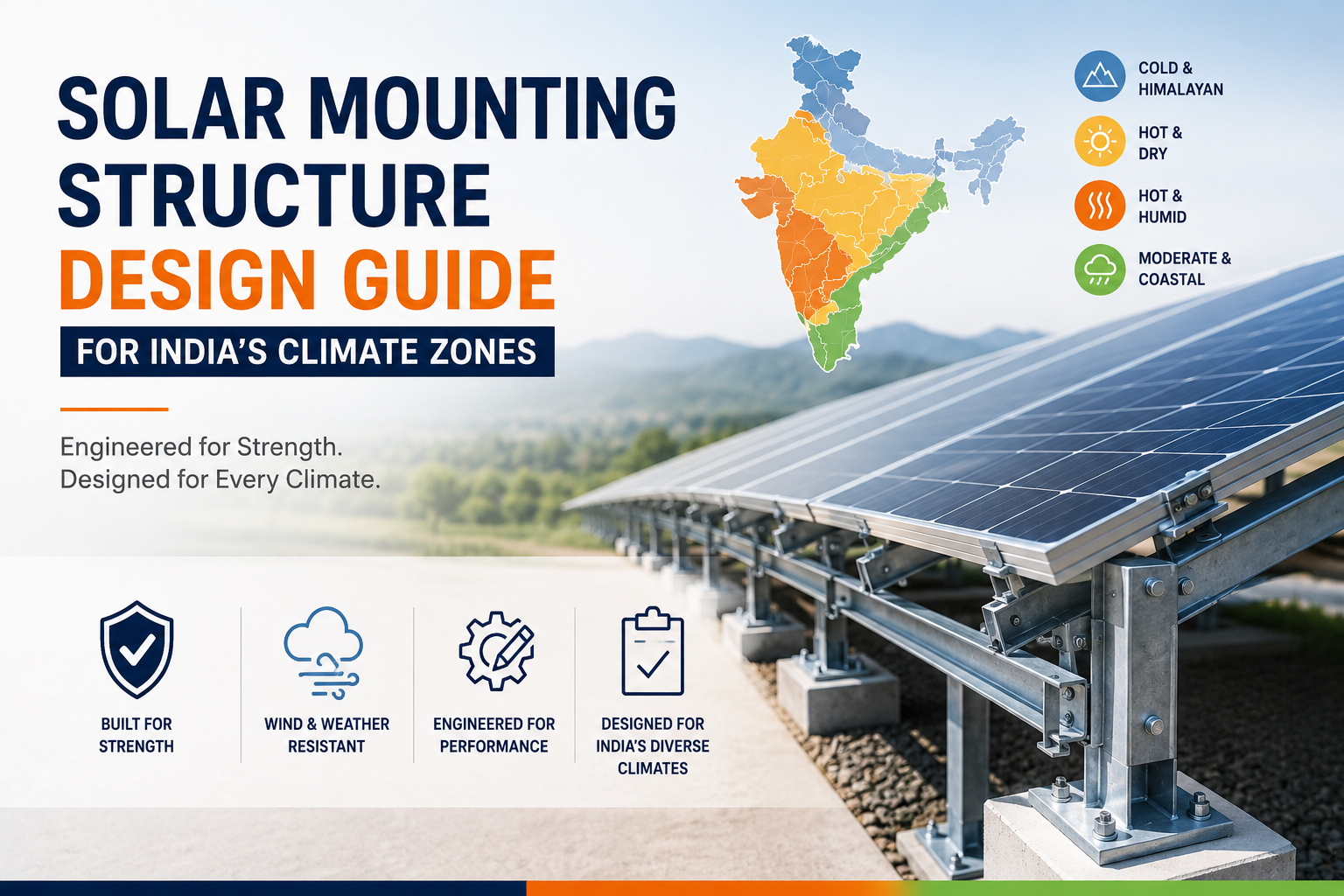
Solar Mounting Structure Design Guide for India’s Climate Zones
India’s solar industry is expanding rapidly, but successful solar projects depend on more than high-efficiency panels. The Solar Mounting Structure forms the backbone of every solar installation, supporting panels through extreme temperatures, monsoon rains, strong coastal winds, and snowfall in mountainous regions.
A one-size-fits-all approach rarely delivers long-term performance. The Solar Mounting Structure Design Guide for India’s Climate Zones helps project developers, EPC contractors, and facility owners understand how climate conditions influence structural design, material selection, and durability.
At Rudran Infra Metals, we understand that solar mounting structures must be engineered to withstand the unique environmental challenges found across India’s diverse regions.
Understanding India’s Major Climate Zones
India’s geography creates several distinct climate zones, each presenting different challenges for solar mounting structures.
Hot and Arid Regions
States such as Rajasthan and interior Gujarat experience high temperatures, intense solar radiation, and dust storms. Structures must accommodate thermal expansion and resist abrasive environmental conditions.
Coastal Regions
Areas along Gujarat, Andhra Pradesh, Tamil Nadu, and Kerala face salt-laden air that accelerates corrosion. Material selection becomes critical in these environments.
High Rainfall Regions
Kerala, Karnataka, and Northeastern states experience prolonged monsoons that demand superior drainage and corrosion-resistant designs.
Snowfall Regions
Himachal Pradesh, Uttarakhand, and Ladakh require structures capable of handling snow accumulation and freeze-thaw cycles.
Cyclone-Prone Regions
Eastern coastal states encounter strong winds and cyclonic storms, making wind load calculations particularly important.
The Solar Mounting Structure Design Guide for India’s Climate Zones begins with understanding these regional conditions before selecting structure specifications.
Wind Load Calculations and Structural Stability
Wind forces remain one of the most important factors in solar structure engineering.
Proper wind load analysis helps determine:
- Foundation requirements
- Structural member dimensions
- Fastener specifications
- Panel layout configurations
- Anchorage systems
Indian standards such as IS 875 Part 3 provide guidance for calculating wind loads. Designers must evaluate:
Site Wind Speed
Different regions experience varying design wind speeds.
Structure Height
Elevated systems generally encounter greater wind pressure.
Panel Tilt Angle
Higher tilt angles may increase uplift forces during storms.
Terrain Conditions
Open fields, industrial zones, and coastal areas influence wind behavior.
Accurate calculations reduce structural risk while ensuring cost-effective material utilization.
Material Selection for Different Climate Conditions
Choosing the right material significantly impacts service life and maintenance requirements.
Hot-Dip Galvanized Steel
Hot-dip galvanized steel remains one of the most widely used materials because of its strength and corrosion resistance. It performs well in most inland regions.
Aluminum Structures
Aluminum offers lightweight construction and natural corrosion resistance, making it suitable for rooftop and coastal applications.
Stainless Steel Fasteners
Fasteners often become the weakest point in corrosive environments. Stainless steel components improve long-term reliability.
Protective Coatings
Additional coating systems may be required in coastal and industrial environments where exposure levels are higher.
Material selection should always align with environmental conditions outlined in the Solar Mounting Structure Design Guide for India’s Climate Zones.
Designing for Monsoons, Coastal Conditions, and Snow Loads
Environmental loads vary significantly across India.
Monsoon Resistance
Heavy rainfall can create water accumulation and foundation erosion if drainage is not properly designed.
Best practices include:
- Elevated mounting systems
- Effective water runoff channels
- Corrosion-resistant hardware
- Reinforced foundations
Coastal Corrosion Protection
Salt exposure accelerates metal degradation.
Recommended measures include:
- Increased galvanization thickness
- Marine-grade aluminum
- Stainless steel fasteners
- Periodic inspections
Snow Load Considerations
Mountain regions require:
- Appropriate panel tilt angles
- Reinforced support members
- Snow load calculations
- Enhanced structural bracing
Projects designed according to the Solar Mounting Structure Design Guide for India’s Climate Zones generally achieve greater reliability and lower maintenance costs.
Foundation Design and Long-Term Performance
Even the strongest structure can fail if foundation design is overlooked.
Key considerations include:
Soil Type Analysis
Different soils offer varying load-bearing capacities.
Foundation Selection
Common options include:
- Concrete foundations
- Driven piles
- Helical piles
- Ballasted systems
Drainage Planning
Proper site grading prevents water accumulation around foundations.
Thermal Expansion Management
Temperature fluctuations can create stress on structural connections if expansion allowances are not incorporated.
Long-term performance depends on balancing structural strength, environmental resistance, and maintenance accessibility.
Why Climate-Specific Design Matters
Many solar projects focus heavily on module efficiency while underestimating structural requirements. Climate-specific engineering reduces the likelihood of premature failures, corrosion-related damage, and maintenance costs.
The Solar Mounting Structure Design Guide for India’s Climate Zones provides a practical framework for designing structures that remain reliable across India’s varied environmental conditions.
Whether the project is located in Rajasthan’s desert heat, Kerala’s heavy monsoons, Gujarat’s coastal belt, or the Himalayan region, customized structural design delivers better long-term outcomes.
Selecting a knowledgeable structural partner can help ensure that solar projects achieve long-term reliability, safety, and operational efficiency.
Conclusion
Designing a reliable solar mounting structure requires more than selecting quality materials. Every region in India presents unique environmental challenges, from extreme heat in Rajasthan and coastal corrosion in Gujarat to heavy monsoon rainfall in Kerala and snow loads in Himalayan regions. A climate-specific approach helps improve structural stability, extend system lifespan, and reduce long-term maintenance costs.
By following the principles outlined in this Solar Mounting Structure Design Guide for India’s Climate Zones, project developers, EPC contractors, and business owners can make informed decisions about material selection, foundation design, wind load resistance, and corrosion protection. Investing in the right structure today can significantly improve the performance and durability of a solar installation for years to come.
Contact Rudran Infra Metals today to discuss your project requirements and get expert guidance on reliable solar mounting structures tailored to your location and application.
FAQs
1. Why is the Solar Mounting Structure Design Guide for India’s Climate Zones important?
The Solar Mounting Structure Design Guide for India’s Climate Zones helps engineers design structures that can withstand regional environmental challenges such as wind, rain, heat, and snow.
2. What material is best for coastal solar installations?
According to the Solar Mounting Structure Design Guide for India’s Climate Zones, aluminum structures combined with stainless steel fasteners often perform well in coastal environments.
3. How are wind loads calculated for solar mounting structures?
The Solar Mounting Structure Design Guide for India’s Climate Zones recommends using IS 875 standards to determine wind pressures based on location, height, and terrain.
4. Can galvanized steel be used in high-rainfall regions?
Yes. The Solar Mounting Structure Design Guide for India’s Climate Zones highlights hot-dip galvanized steel as a reliable choice when proper coating thickness is maintained.
5. Why are snow load calculations important?
The Solar Mounting Structure Design Guide for India’s Climate Zones emphasizes snow load analysis to prevent excessive structural stress in Himalayan regions.